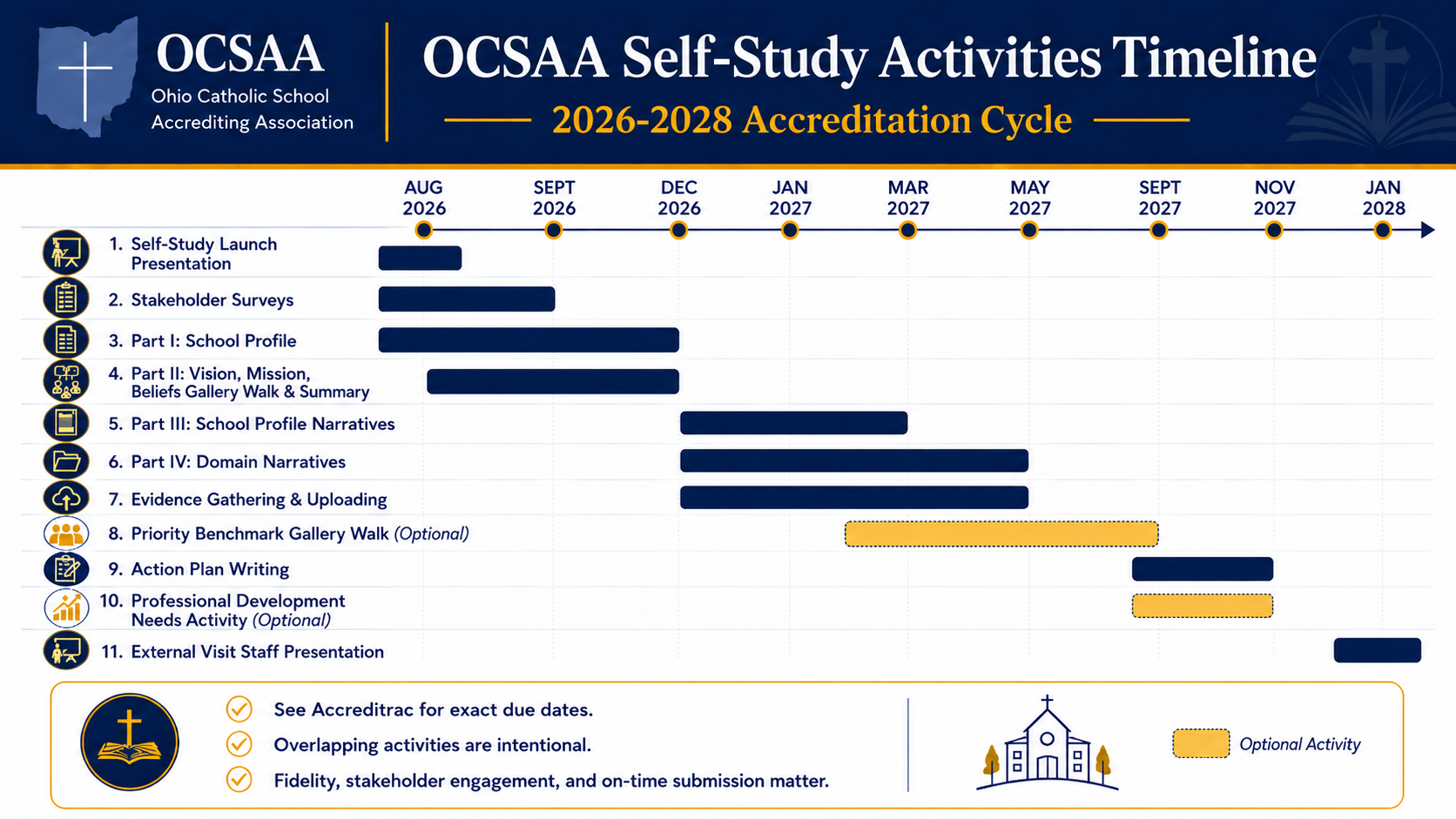
OCSAA supports the work of our schools through a six-year accreditation cycle which includes a self-study, data gathering and analysis, goal setting based on data, professional development, assessment of progress toward goals, and reflection and revision as necessary.
As each school engages the process, it moves toward the vision of a high-performing school where students are grounded in their faith and prepared to achieve at distinguished levels. The OCSAA process challenges schools to set goals and offer instruction using best practices and research.
Are you an administrator looking for updated self-study resources? Click here for administrator resources.
Essential Marks of Catholic Schools
Archbishop J. Michael Miller’s book titled The Holy See’s Teaching on Catholic Schools highlights the essential marks of Catholic schools.
According to Archbishop Miller, a school forms a Catholic identity when it is:
- Inspired by Supernatural Vision
“The specific purpose of a Catholic education is the formation of boys and girls who will be good citizens of the world, loving God and neighbor and enriching society with the leaven of the gospel, and who will be citizens of the world to come, thus fulfilling their destiny to become saints.”
- Founded on a Christian Anthropology
Archbishop Miller reminds us that Catholic schools have the task of being the living and provocative memory of Christ in addition to insuring a culture of academic success.
- Animated by Communion and Community
This places emphasis on the school as community with teamwork, cooperation, interaction. Even the school’s physical environment has value in creating “a genuine community of faith.”
- Imbued with a Catholic Worldview Throughout Its Curriculum
“Catholic education is intentionally directed toward the growth of the whole person. An integral education aims to develop gradually every capability of every student: his or her intellectual, physical, psychological, moral, religious capacities.”
- Sustained by Gospel Witness
Faculty and administrators play a vital role in creating and sustaining the school’s identity in accordance with the teachings of Jesus Christ.
“No child shall be denied his or her right to an education in faith, which in turn nurtures the soul of the nation.”
Pope Benedict XVI
The Six-Year Cycle
By successfully following a six-year accreditation cycle and process, Catholic schools maintain their accreditation. In keeping with the mission of the OCSAA, the process has as its hallmark continuous improvement which centers around two student-learning goals and a plan designed to implement those goals. There is a Catholic Identity goal and an Academic Performance goal.
Faith in action is love, and love in action is service.
Mother Teresa
These two goals involve all academic disciplines and grade levels. The Catholic Identity goal focuses on faith in action – students demonstrate what they have learned through religious instruction. The Academic Performance goal involves content knowledge, information, and skill development as it is applied to real-world problems, situations, and experiences. Skills and experiences are deepened and enhanced throughout the four-year plan.
All guidelines, instructions, forms, reports, and steps in the process are provided to member schools in a document titled “The OCSAA Handbook .”
Membership Info
Operating Standards
Catholic schools provide curricular and co-curricular experiences which are academically rigorous, relevant, research-based and infused with Catholic faith and tradition.
National Standards and Benchmarks for Effective Catholic Elementary and Secondary Schools
Member schools follow state Operating Standards as promulgated by law and adopted by OCSAA; as Catholic schools, we have added Catholic Identity standards to reflect our uniqueness. The State Board of Education has approved the OCSAA Operating Standards.
Through the OCSAA process a new Catholic school can apply for a charter. For established Catholic schools, the process involves maintaining an existing charter, ensuring ongoing compliance with OCSAA operating standards.
OCSAA Operating Standards
Annual Verification of Standards
“Catholic educators are expected to be models for their students by bearing transparent witness to Christ and to the beauty of the gospel.”
Archbishop J. Michael Miller, CSB
OCSAA works closely with diocesan leadership of member schools and administrators of member schools to ensure compliance with standards, including but not limited to state law and Ohio Department of Education and Workforce rule and policy.
OCSAA works with diocesan superintendents to monitor personnel credentials, required inspections, and the number of instructional hours.
To be considered an accredited member in good standing of OCSAA, all schools are required to regularly enter accurate data into the web portal.
Schools are responsible for complying with all Operating Standards at all times. A school's principal must monitor and address any non-compliance issues.
About OCSAA